Many around the world can recognize the famous quote from “Hamlet:” “To be or not to be–that is the question.” What many don’t know is the history behind Shakespeare’s family and his son Hamnet that the film “Hamnet” explores.
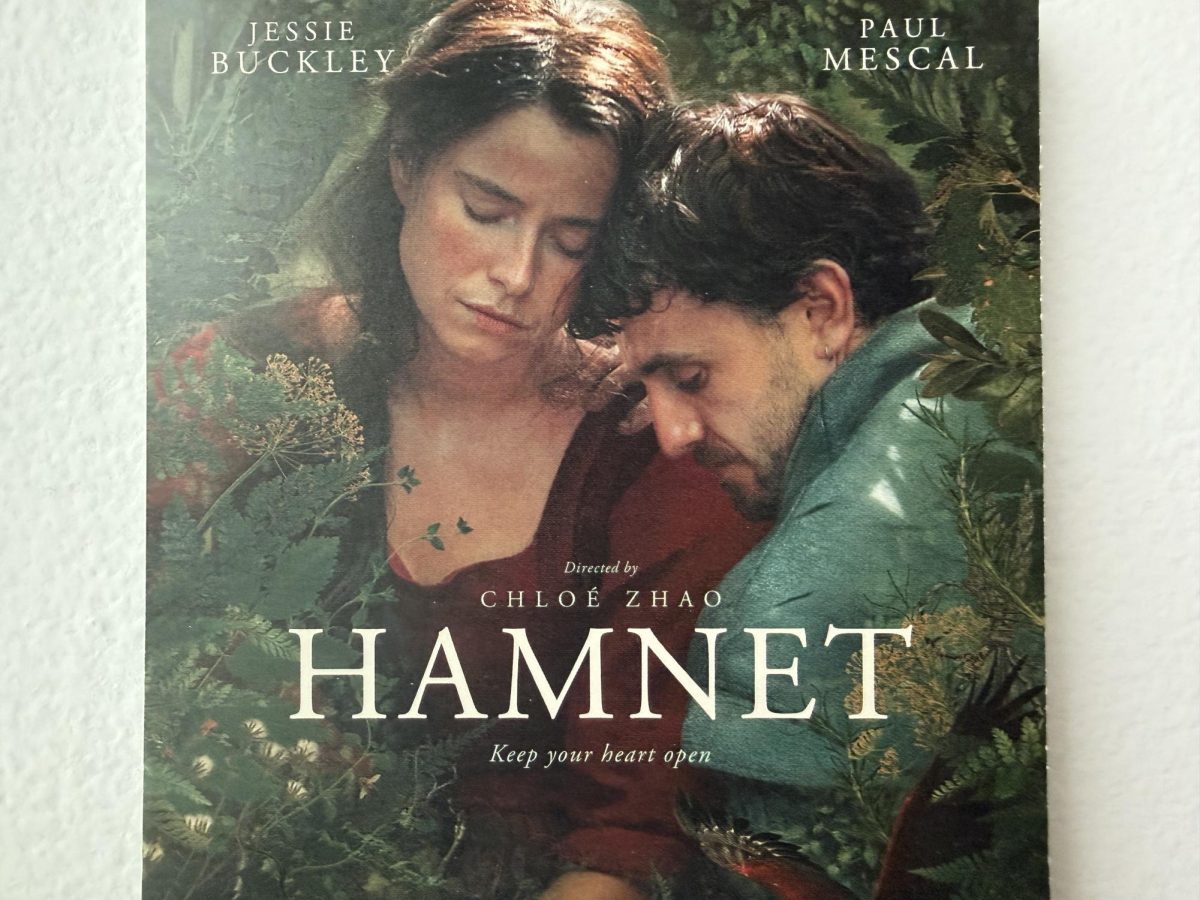
“Hamnet” began its limited release on November 26th and expanded nationwide on December 5th. The film is directed by Chloé Zhao and stars Jessie Buckley and Paul Mescal. It’s rated PG-13 and currently sits at an 86% on Rotten Tomatoes and an 8.1/10 on IMDb.
The film follows William Shakespeare (Mescal) and his wife Agnes (Buckley) through their love, domestic life with children and the complications that come with the fear of fate looming over their heads. Ultimately, their son Hamnet dies and their grief sparks the creation of the famed play “Hamlet.”
“Hamnet” is based on a historical fiction book of the same name written by Maggie O’Farrell; the events that take place are only partly based in fact. While the film suggests Hamnet’s death had a major role in inspiring Shakespeare to write “Hamlet,” it isn’t a theory that is widely accepted among historians. Instead, many historians agree that the folktale “Amleth” was the main inspiration for “Hamlet;” so to help the cast and crew portray O’Farrell’s interpretation of history, she helped co-write the film’s screenplay.
The standout performance of the year is given by Buckley as Agnes. Throughout the film, Agnes’ story follows the three stages of life: the maiden, the mother and the crone which are parts of womanhood that respectively represent learning, nurturing and wisdom. Buckley portrays each phase of life not as three separate parts, but one smooth transition where she’s able to build upon her past, but not leave it in the past. The particular moment when Agnes calls out for her own mother while she’s giving birth solidifies this connection of phases, especially because of how Buckley taps into the fear and anticipatory mourning that Agnes feels.
Starring aside her is Mescal as Shakespeare; his portrayal of Shakespeare gives a different look into grief compared to Agnes’ experience. It’s a hurt that at first can seem devoid of caring, but Mescal is able to bring out the subtle and private moments of Shakespseare’s misery, like when he’s crying in the theater wings during the debut “Hamlet” show, that shows the human side of this historic people that many don’t think about. This is especially highlighted in relation to the few scenes about the creation and performance of “Hamlet.”
Zhao is a director that directly speaks to the human experience and the emotions that come along with this, especially in how they connect to love, which made her the perfect fit for directing “Hamnet.” Her delicate, but caring approach to Agnes’ grief doesn’t leave the audience simply feeling sad, they feel connected to Anges’ loss and sorrow because Zhao evokes the audience’s personal grief they’ve felt when they lost someone close to them by not shying away from the hardest parts of loss while also keeping a tender outlook on those emotions. She also doesn’t leave her characters’ arcs emotionally unsatisfied: everyone feels like they get some sense of closure, a feeling that translates to the audience that can help them process their own emotions.
The deeply moving score was composed by Max Richter. When composing the score for “Hamnet,” he combined both a string orchestra, women’s choir and period accurate instruments such as viols, nyckelharpas and a hurdy-gurdy. The combination of all three of these musical aspects gives the score a spiritual feeling; the scene where Agnes and William are getting married features the choir mixed with the orchestra to create a feeling of spiritual love between the characters, but the audience as well.
“Hamnet” is an emotionally raw film that doesn’t shy away from any part of grief, creating an experience that resonates with audiences through the shared feelings that come with loss.