



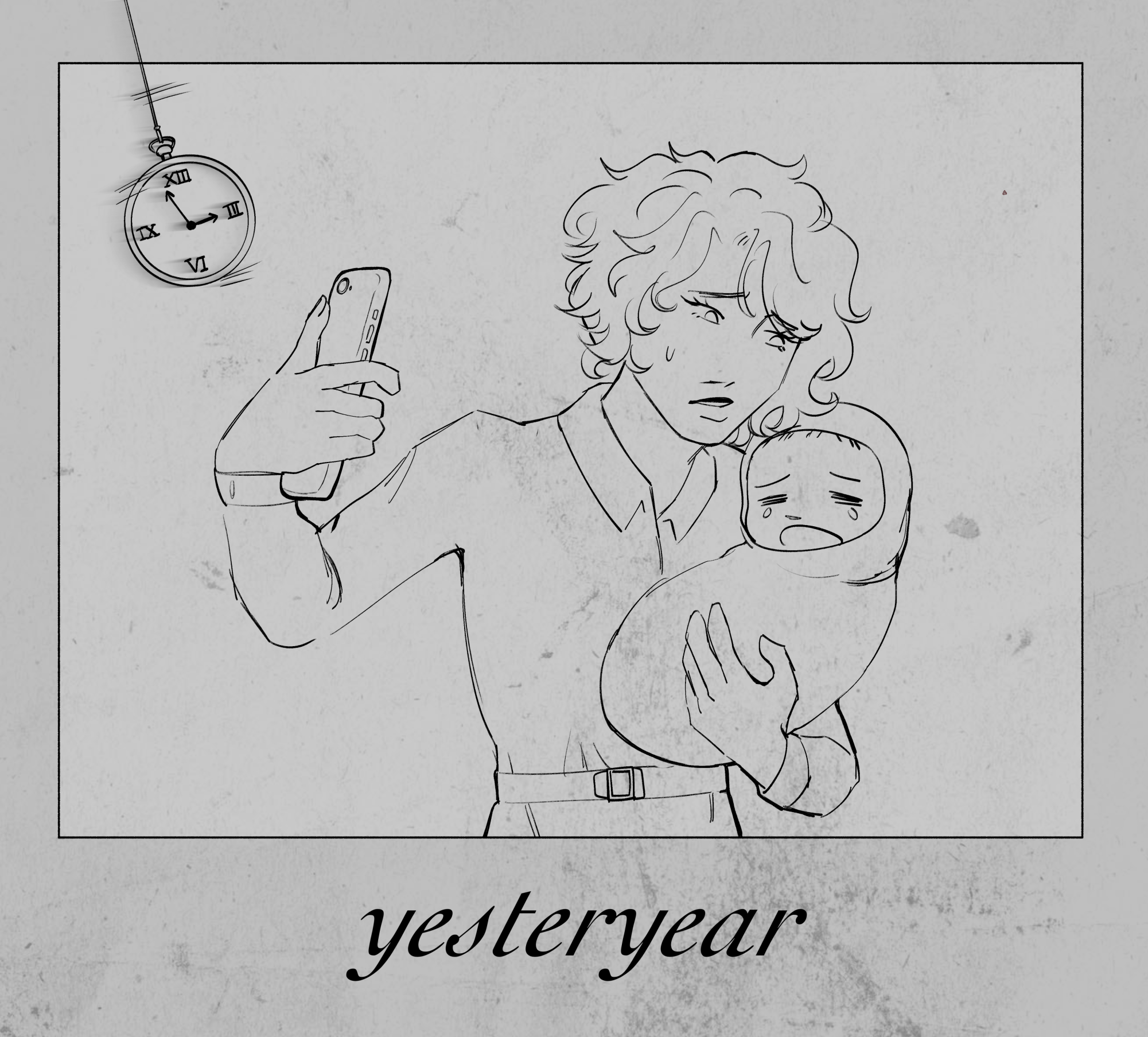
Everyone has heard the name Nara Smith, the famous influencer known for her traditional cooking videos, and mostly everyone has heard of the term “trad-wife.” In Caro Claire Burke’s “Yesteryear,” readers follow a similar trad-wife who seems like a conglomeration of all the various trad-wife influencers out there. In a time of increasing popularity for trad-wife influencers, where cooking and casual day in the life videos romanticize the lifestyle, “Yesteryear” hones in on one woman’s experience with satire and irony.
“Yesteryear” tells the story of Natalie, a trad-wife influencer who runs an old-fashioned farm with her husband and their many kids. Online, she has the picture perfect family, though in reality everything about her farm life is carefully calculated, and her children are beginning to resist being recorded for content. Still, Natalie has it all under control—until she wakes up in 1855, in an eerily similar house, but with a husband she doesn’t recognize, and children who are not her own.
Natalie doesn’t know whether she’s actually traveled to the past or if she’s being maliciously recorded for a reality TV show, but she wants to get to the bottom of it. What follows is a gripping read, not only of Natalie’s current state, but also flashbacks to her formative college years.
As a college student, Natalie grapples with extreme loneliness as she struggles to fit in with women who are less religious than her. Her time as an outcast embitters her, providing the foundation for the superiority complex she has later in the novel.
The book starts off strong, leaning into cliches when necessary while upending others.
At the same time Natalie’s inner monologue reveals her extreme antagonism to other women, her biting remarks also reveal her deep awareness of the world around her. Contrary to the stereotypes about trad-wives, Natalie is not impressionable or powerless, but calculating of the lifestyle she’s creating for herself. Burke crafts Natalie to be a compelling, surprising character, something that hooks readers along the way and adds complexity to the satire.
Despite the novel’s strong start, the book never takes off beyond the promising premise. Burke seems to write with the assumption that her readers are aware of modern discourse about the trad-wife lifestyle, including discussions of internalized misogyny, traditional patriarchal values and white supremacist aesthetics. These themes are never truly interrogated, only mentioned off-hand.
Because of this, the satire Burke creates falls flat. As the book grows more unhinged, readers are increasingly interested in the final reveal, but may lose sight of what Burke is trying to comment on in the first place. The plot twist reveals a deceptive set-up that detracts from the message and makes the readers feel click-baited into reading the story.
The book ultimately seems like a case study of the character herself as Natalie’s experiences become increasingly specific and divergent from a typical trad-wife/influencer lifestyle. While Natalie cleverly subverts the readers’ initial assumptions about her, her character eventually devolves into the one-dimensional trope of a mad woman. By the end of the novel, Natalie lacks clear motivations for her crazed actions–she is not complex enough as a character to make for a strong character study.
Nevertheless, “Yesteryear” is an interesting read, even if not a particularly thought-provoking one. The author’s clever and effortless prose, as well as her strong sense of pacing, demonstrate that she has potential to craft something truly great. Readers should definitely be on the lookout for her next release.