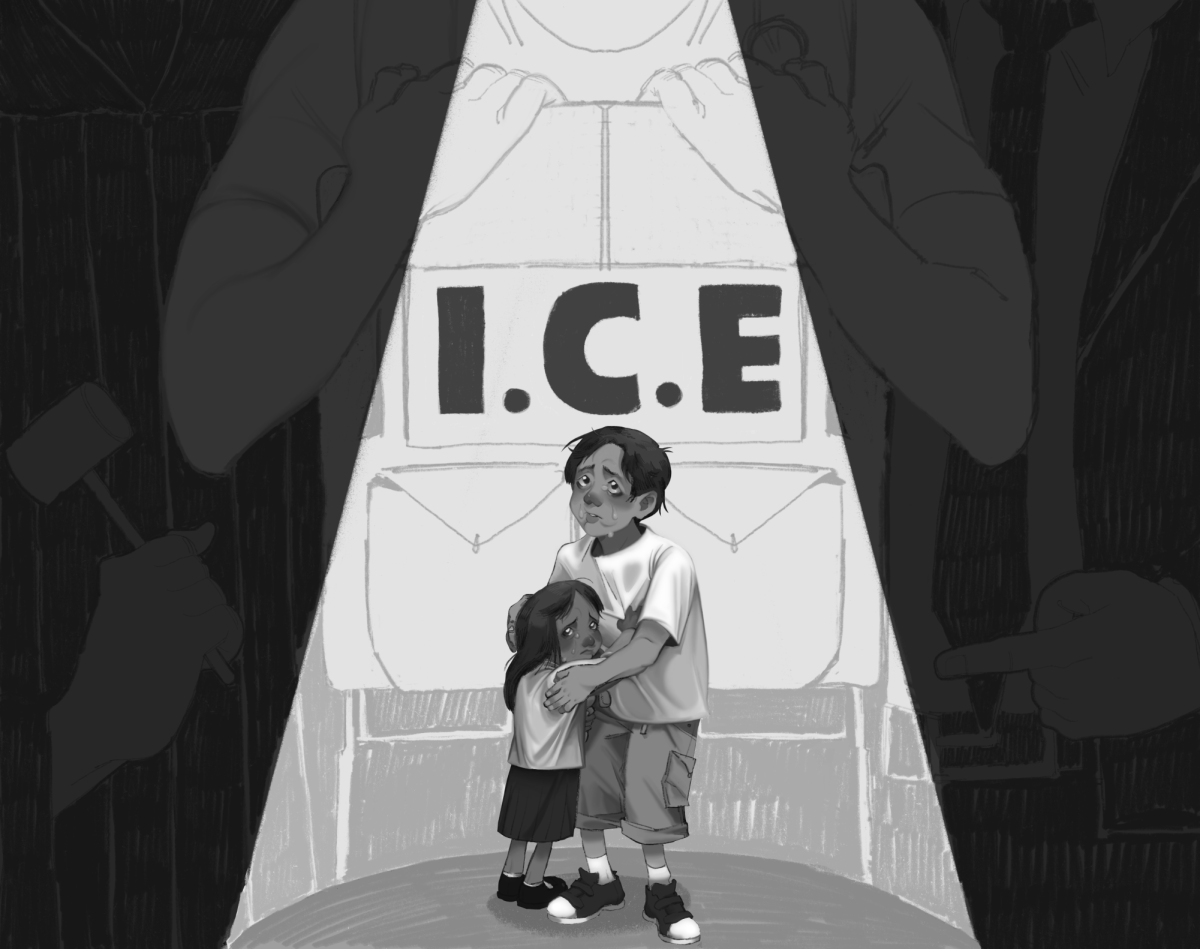
As a part of President Trump’s campaign promise to deport millions of illegal immigrants, the Department of Homeland Security, DHS, states that they have deported over 2 million individuals since the start of his term. DHS has dubbed ICE’s deportations in Chicago “Operation Midway Blitz,” which started on Sept. 8.
In the recent Noem v. Perdomo decision, the Supreme Court decided 6-3 that certain physical traits allowed federal agents to stop an individual. Justice Brett Kavanaugh wrote in a concurring opinion that speaking Spanish, speaking English with an accent or one’s apparent race or ethnicity were grounds for whether ICE could legally stop an individual under suspicion of being undocumented. In a dissenting opinion, Justice Sonia Sotomayor states that Americans should not have to live in a country where anyone who looks Latino or speaks Spanish could be seized.
Chicago Public Schools, CPS, science teacher at Mark Skinner West Elementary School Les Seitman recently celebrated his 20th anniversary with CPS. With experience in areas like Little Village, Brighton Park and Belmont-Cragin, he noticed ICE’s effects on the community.
“I don’t feel like any community has been removed from [ICE]. Just over the weekend, my 8th-grade ELA teacher had his block tear-gassed by ICE. He lives right by Wrigley Field, and he has a newborn. I feel for students, it’s added another layer of something to worry about. Kids shouldn’t have those problems,” Seitman said.
ICE has also created a difficult atmosphere in the Downers Grove community, with families and students having to face the possibility of deportation.
Spanish teacher and equity and inclusion coordinator Georgina Cervantes spends time with students who may need support in the face of ICE in the Downers Grove area and has seen the effects.
“It’s a heavy year because not only do they come in with language barriers and instructional needs, but we are also trying to make them feel safe and make them feel comfortable while they’re learning. But they’re just overall in fear, especially because they’re hearing from their friends [that] ICE has raided certain family members of their friends, or their own families have been taken,” Cervantes said.
Counselor Dan Mustari agrees with Cervantes’s statement about students living in a state of fear.
“I think it’s made people feel on edge and fearful; No matter what your background is, it affects you, even if you don’t feel it or see it directly. I think it’s created an atmosphere of nervousness, as it does affect our neighbors, our parents [and] our workplaces. We are a very diverse community, so because of that, we all have some type of connection [to] it,” Mustari said.
However difficult the situation may be for students, DGS is offering support for students wherever they may need it. DGS has created a “Know Your Rights” protocol similar to Chicago’s. On Nov. 3, due to family and student concerns, District 99 released a statement detailing new regulations implemented concerning ICE near school grounds.
The regulations include: immigration enforcement is not permitted on school grounds during the school day, any immigration enforcement officers must be directed to the superintendent and federal officers must present a criminal warrant before District 99 cooperates.
Principal Arwen Lyp is focused on students feeling safe at school and supporting families as needed.
“We know that school is a safe place. The other ways to keep students safe is just to be very aware of the ‘know your rights’ information; we know here at school that adults are equipped with the ‘know your rights’ information and to connect families and students to outside agencies that can provide support, and for families to be aware of the community groups that are all rallying around to help support families,” Lyp said.
Students have access to many resources like their counselors, psychiatrists and equity and inclusion coordinators. Equity and inclusion coordinators Kierstin Thompson, Elelyn Golden and Cervantes are available to help students talk about their experiences, set them up with lawyers and offer other resources.
“We have the mission and vision of ‘we belong here,’ that’s our whole logo and our whole theme. So I think just reassuring these students that no matter what background they come from, they belong here. Just having empathy for certain students, specifically if they come from different backgrounds, and just being able to understand them and help them out,” Cervantes said.