
The passing period bell rings, crowds of students flood to the commons – it’s lunch time. While some pack their own nutritious meal or opt for a salad, students buried in endless assignments and exhaustion from early morning practice often clutch their Bubblrs and a bag of chips to gain energy before their next class.
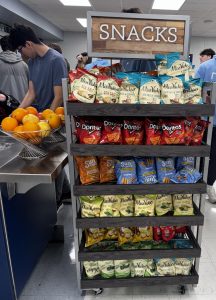
Endless chip flavors line shelves, sugary drinks and greasy slices of pizza are available in abundance at various lunch-buying locations. Amongst these selections, salads reside in a humble corner in both the cafe and stable, and although available, they aren’t advertised in the same way as the sugary bakery items in the cafe.
Across the hall, students in health classes are learning about the importance of healthy eating, knowledge that is immediately refuted during lunch periods. Health teacher and volleyball coach Madisen Babich reflected on the disparity between student nutrition in class versus in practice.
“It is definitely contradictory. We push in our health rooms and every class what a healthy student should be doing, even when it comes to tying into their focus in class all day, and then we’re offering nothing but unhealthy food in both areas of the cafe and the cafetorium. We’re being hypocritical,” Babich said.
Students don’t intentionally ignore healthy food, yet navigating a busy schedule and balancing time leads them to prefer convenience and pushes them toward unhealthy options, especially when the school environment implicitly enforces these choices.
This is the world many students have grown up in. In a country where nearly 200 million children under the age of five suffer from undernutrition, and another 40 million suffer from being overweight or obese at the same age, eating habits are often instilled within students long before they enter high school.
According to the National Library of Medicine, higher consumption of ultra-processed food is associated with a 22% higher risk of all-cause mortality. However, ultra-processed foods have been served in schools in many countries, including Brazil and the USA.
Freshman Mason Fuller sees the school’s food offerings as an extension of the lifestyle he leads.
“I just like treats. I don’t really have time in the morning to stop and get something. So I usually just get something from the school, and I know it’s going to always have this sweet stuff all day,” Fuller said.
Fuller shares the reasoning behind his unhealthy eating habits.
“Sometimes I feel like with the healthy food, they definitely don’t give you enough, but the sweet treats, there’s always so much of it. There’s only two healthy items, but you can always get two slices of pizza, a bunch of nachos, coffee and donuts in abundance. Furthermore, the cafe is always open much longer than the healthy options are, so if I’m hungry during resource or one of my break times, I always have to get the unhealthy snack anyway,” Fuller said.
For athletes who need to fuel their bodies before high levels of physical activity, school offerings are often insufficient. As a volleyball coach, Babich is able to understand the difficulty of maintaining a balanced diet through school meals.
“I think it’s difficult for them to choose to eat a salad every day. It’s doable here, but I feel like that’s really our only healthy option. If we could have healthier, fresh daily fruit options actually in the cafeteria area where they’re serving salads, I think we just need to have more options and offer more for them to choose from on the healthy route,” Babich said.
Babich recognizes the monotony that comes with eating one of the sparse healthy options at DGS, but also recognizes the financial struggles that come with school budgeting.

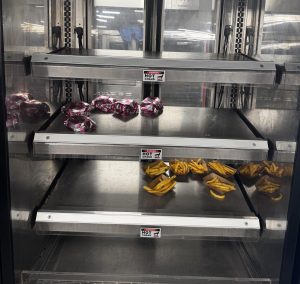
“At the end of the day, a teenager is going to get sick of salad, so we have to have a wider range of healthy options in order for them to make it easier on them. … [There is also] a financial factor on those types of decisions and offering the less healthy food that we do in the cafeteria right now is just an easier financial decision for our school,” Babich said.
This issue has encouraged senior and D1 committed golfer Miah Wanserski to pack her own nutritious meals. She has made the decision to buy her own groceries and meal prep to ensure that she is fueling her body with the required nutrients to help improve her athletic performance. The meals she prepares are often extremely nutrient dense, consisting largely of whole foods and clean ingredients.
“It’s easy for me to eat healthy at school because I buy all my groceries on the weekend so I can plan out my meals…My lunches are usually Greek yogurt with fruit, or chicken with rice and vegetables. I don’t pay attention to the school environment that much because I choose to make my own meals, but because I can’t correctly guess the nutrition value or calories per meal, I like to avoid them,” Wanserski said.
Although Wanserski is one of the few who are fortunate enough to build their own meals, whether it’s for convenience or financial issues, many students are unable to do the same.
Although these highly processed snacks dominate the school mainstream, there are measures in place to ensure that the food served at DGS meets FDA (Food and Drug Administration) requirements. Cafetorium cook Dushanka Glenn shares the process behind choosing the food that schools are allowed to serve.
“The school does pretty good promoting healthy lunches. They go to a meeting with the food company to see what they can sell and what they don’t want to sell,” Glenn said.
She expresses her appreciation and gratitude for the expansive selections offered at DGS compared to various other schools.
“They have a lot of options, I was shocked. This is my first year here, and compared to Chicago Public School, this school here has a lot more options than the Chicago public school. Everything here is fresh, and it’s cooked daily. You can get your milk, your water, your fruits, your vegetables and your protein,” Glenn said.
While the healthy options do technically exist, that doesn’t mean this is the choice students will make, or if they are even able to make that choice at all. Although rare, there are students at DGS who don’t even have a scheduled lunch period, making eating a nutritious meal difficult. Councilor Cory Rasho makes it clear that the choice not to eat lunch is a direct student choice that the school has no power over.
“We make [students] have parent permission because if there’s something underlying what they need or their parents would be worried about their nutrition, then they would be the ones that are on the stock,” Rasho said.
If schools want to provide a healthy environment for students, then an abundance of healthy offerings is critical.
“I think it’s all a struggle, so we’re going to always be in this cycle and circling about this idea of yes, we’re trying to make things better and do better, but that costs money, and then also we need to support these kids and be able to provide food for them too,” Babich said.
By the time the final bell rings, the pattern repeats itself. Students navigate the halls, snacks and drinks in hand as they walk to class, leaving behind balanced meals. But while the options haven’t disappeared, for many students, the ability to choose them has.