


AI codes itself into everyday life


“Because of this app, I finally feel connected to God,” reads a Google Play review of Bible Chat, the app that lets users seek spiritual guidance from an artificial intelligence program. Although this type of AI usage may seem out of the ordinary, this example is a marker of how ubiquitous AI has become. Following the release of AI programs such as ChatGPT, Gemini, and Leonardo several years ago, conversations surrounding the use of AI have become rampant.
At DGS, discussions about AI are usually tied to academic integrity and teachers’ worries about the plagiarism AI may enable. Yet, educators and students have also witnessed the rise of AI-powered study tools, whether through Khan Academy’s modified ChatGPT model, DuoLingo’s implementation of AI, or Knowt’s utilization of AI to quickly generate flashcards.
Quite simply, AI is everywhere. It may even be more versatile than one might initially think.
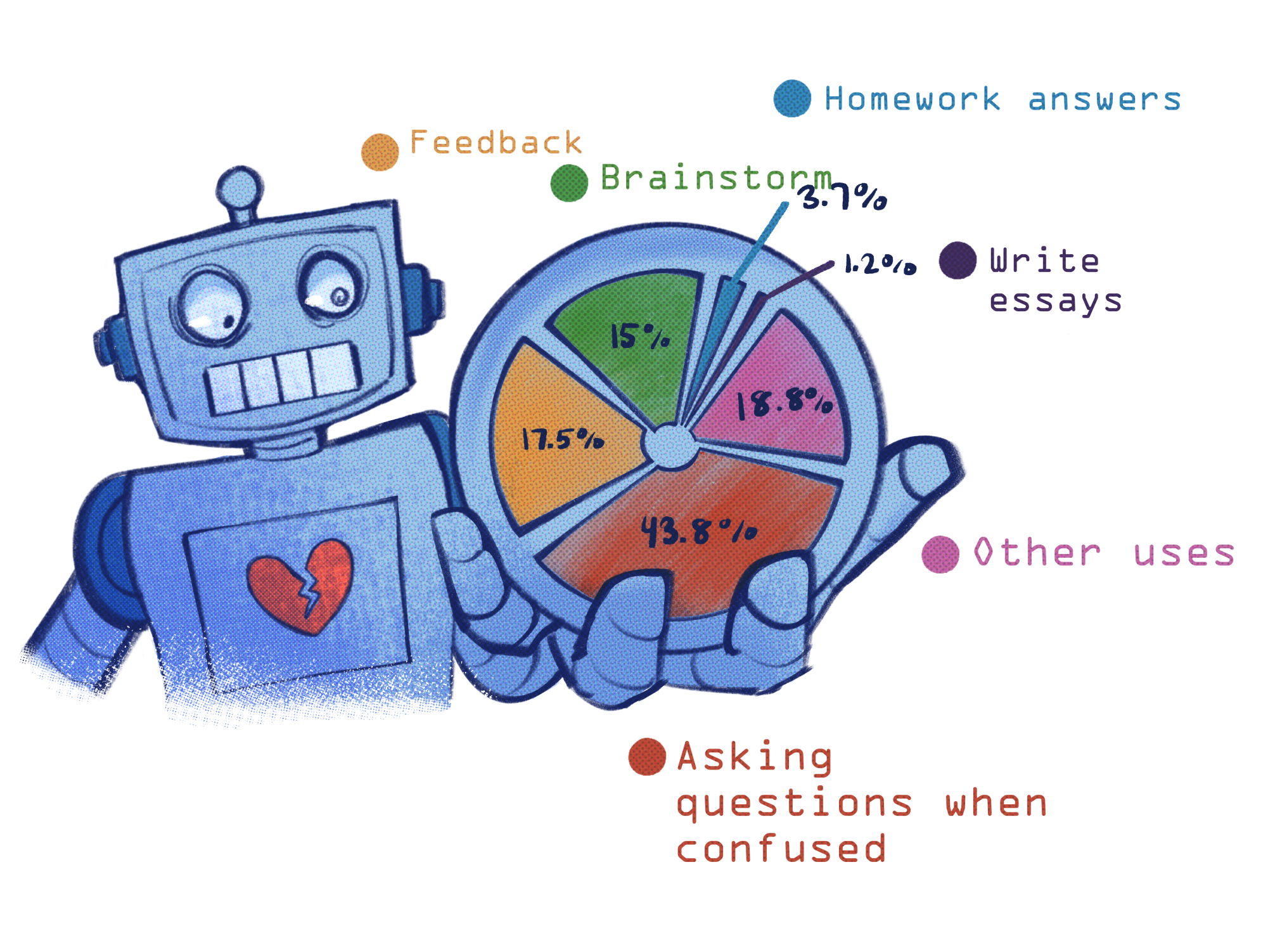
In a survey of DGS students, responses about how students used AI ranged from “how to do hair” to “create a good budget plan,” with 55% of the 191 students who responded saying they used AI for non-academic purposes. For some people, AI can be a helpful tool, not merely a way to entertain themselves. Senior Sarah Gerges-Rodriguez describes the potential pros of using AI.
“[AI] is pretty good at learning and adapting pretty quickly, so I feel like it could help students and teachers at times to work together and kind of have, like, a more customized agenda,” Gerges-Rodriguez said.
Gerges-Rodriguez acknowledges that some people may simply be copying from AI, especially because AI use is so widespread at DGS: 77.7% of DGS students surveyed about AI usage said they used AI in class, whether their teacher allowed it or not.
“As long as [students are] still learning, it’s not that big of an issue,” Gerges-Rodriguez said.
The above statement seemed to be equally important to Associate Principal Jacob Giblin, as he described how AI would be used in his ideal world. He discussed how being a math teacher influenced his current mindset about AI, referencing how both mathematicians and students who use AI are looking for shortcuts.
“It is possible by using [AI] in a correct way, you can get study help,” Giblin said, considering a potential situation where a student has no one at home to help them with their math struggles. AI might be a quick and effective solution for this student.
Outside of a school context, AI has a multitude of applications that our world is continuing to work through. Senior Sofia Sanchez talked about how AI can be utilized in careers and real-world problems.
“Especially in our new scientific age of society where we would like to upgrade our utilities, [AI] could be useful in that way to show what other ways it could be used, for medical reasons, helping with surgeries, for engineering, what ways could we build buildings,” Sanchez said.
At the end of the day, those at DGS seem to agree that AI usage is a balancing act between its potential benefits and consequences.
“I want people to be creating and developing themselves,” Giblin said.
It’s up to students and teachers whether AI is a part of that vision or not.
The impact artificial intelligence has on the world extends far beyond the educational system. Experts warn that the advancements of AI technology could account for up to 4% of global electricity consumption by 2026. This primarily stems from the data centers that create and train AI models, requiring specialized computers and large amounts of energy to run them.
Science classes at DGS, such as AP environmental science, educate students about the adverse effects of carbon emissions. Senior Sam Reichl reflected on what she learned in class in relation to her current understanding of AI.
“In AP environmental science, we learned about all the places greenhouse gases are released, and I didn’t know AI was also causing environmental damage. I think it’s definitely something to be concerned about,” Reichl said.
In addition to energy consumption, AI technology heavily relies on water supply. The hardware that generates AI models requires water to cool servers in data centers. This global annual water consumption is on track to reach over 6 billion cubic meters in just a few years.
“These cooling towers use millions of liters of water annually, and this has begun to stress local supplies,” Christopher Gales, a biology and environmental science teacher at .
DGS said
Gales added that the water demand from data centers has a direct impact on agriculture, using up resources from water-deprived areas. It is drying out lakes, rivers and oceans — the sources relied on every day, all around the world.
“A lot of pollution also comes from the extraction of natural resources. Mining for rare earth elements and metals for chips and batteries harms habitats and water sources,” Gales said.
Environmental scientists are currently developing mitigation strategies to address these issues. These efforts aim to significantly reduce the impacts of AI on our global carbon footprint.
One strategy focuses on transitioning data centers to renewable energy sources. Many data centers have established agreements and tariffs to purchase 100% renewable energy from providers. There are also on-site advancements being made, such as solar panel and turbine installations.
Another method involves using liquid cooling and heat-reuse systems to cut water and energy waste. Liquid cooling is used in data centers to cool down the computers that create AI models; the systems are designed to circulate liquid around hardware. Heat-reuse systems capture excess heat in the centers and repurpose it as heating in other locations.
As AI continues to advance, it is essential to prioritize sustainability in its development. Scientists are working on constructing ways to reduce the negative impacts, but there is still significant work to be done. Ultimately, the future of technology and the planet rests on the choices made by society today.

With new advancements in technology, society becomes increasingly more dependent on artificial intelligence. Google has integrated an AI summary feature, Snapchat has an AI chatbot and Instagram has meta AI. This is an evolution of technology, no different from email or FaceTime – unlike the others, this one is unavoidable.
The head of the IT department Philip Howard expresses his concern about AI becoming more prevalent in today’s society.
“I think when tools are closely integrated with the platform and there’s a blending of the old tool versus the new tool, I think there’s a lot more risk to that. One of the things that makes me a little bit nervous is that, I know Snapchat has a little AI tool that you can talk to, I actually think that’s a fairly risky proposition,” Howard said.
He does, however, believe that AI use will not be stopping anytime soon as it’s a tool that has been rapidly growing and integrated into many aspects of technology. He expressed his beliefs regarding the potential it has to aid society in various ways.
“The tools of AI, especially the generative AI, are going to be everywhere. You’re gonna go to a fast food place eventually, and it’s gonna take your order – you’re not going to get to choose. There’s going to be a lot of opportunities where you’re simply not going to be able to avoid engaging with an AI tool in that way,” Howard said.
As AI becomes more prevalent in society, taking the steps to avoid it is oftentimes more difficult than engaging in it. Sophomore Marjorie Breuggemann expresses her contemplations about moving towards an AI-dominated world.
“Anywhere you’d go on the phone. And you have to go the extra step to get rid of it [AI] instead of adding on,” Breuggemann said.
Breuggemann commented on how she believes it will affect our rapidly evolving world.
“I try to tell when things are AI, but even, like, it’s getting to a point where I can’t really,” Breuggemann said.
As Artificial Intelligence becomes more integrated into everyday lives, new information reveals the drastic effects that AI can have on the human brain.
According to an MIT study in 2025, the increasing use of ChatGPT has decreased our ability to generate ideas. Additionally, they also say that they have found a correlation between increased use of ChatGPT and lack of creativity among people.
Senior Casey Patten has seen this in her own life.
“I have noticed a decline in my creativity,” Patten said, “I have found myself reaching for AI instead of taking time to figure it out on my own.”
This increase in AI usage, especially in the classroom, has been noticed by teachers as well. AP Psychology teacher Kimberly Pazdan said she believes that there is a good chunk of her students who use AI.
When it comes to a decrease in the ability to think critically, “I haven’t noticed yet, but this is truly my biggest concern as a teacher of Psychology. I think it is going to be my job as a teacher to figure out how to encourage critical thinking and skepticism, even in terms of what AI produces,” Pazdan said.
Although students and workers have only had access to AI generators like ChatGPT for four years, MIT says using AI on just one assignment can decrease neural connectivity and decrease memory recall. It is for this reason that many educators are asking for AI use in school to be limited.