



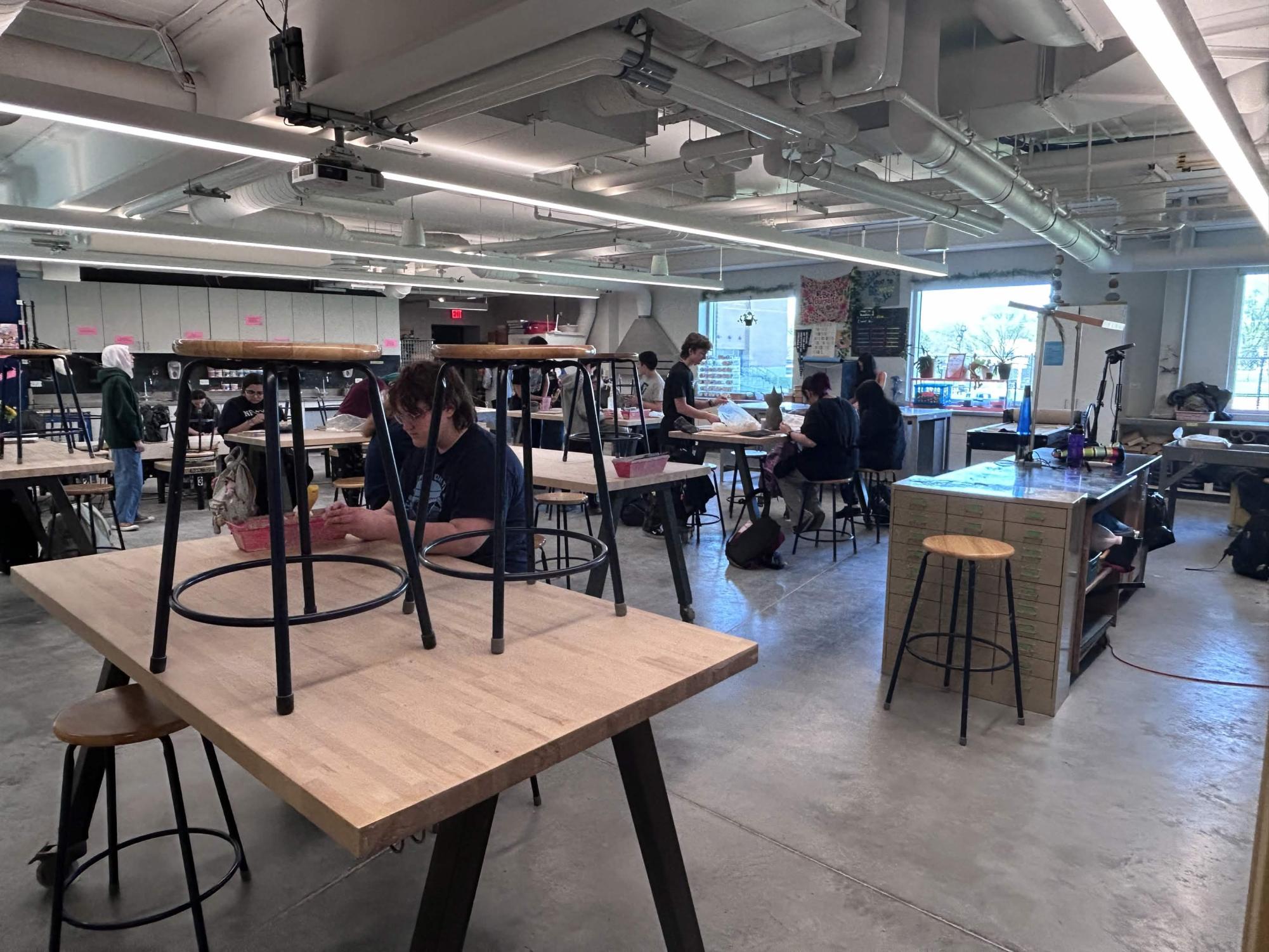
The time is 3:30 p.m., and the daily reminder on the intercom rings throughout DGS, alerting students and faculty that it’s time to race to the rooms that their clubs are held in..
“At this time, all students should be in their designated afterschool locations,” associate principal Omar Davis said, “all students should be participating in athletics, activities or other events under the supervision of an adult staff member.”
Students and teachers go about their lives in a variety of ways, with specific interests that are reflected in the way they connect with local communities. School clubs are common ways for students to express their interests, providing community and opportunities not normally available for the general student body. For teachers, being a club supervisor can be an intense commitment, with many fitting those responsibilities into their schedule over time normally spent with family.
During the fall and winter seasons of the 2025-2026 school year, DGS collected data on student involvement in both athletic and non-athletic extracurricular activities, the number of students involved and their attendance rates. During the fall, around 95.58% of 2,153 students took part in registered non-athletic extracurriculars, and in the winter time, the numbers stayed consistent, with 93.48% of 2,187 registered students participating in one of 54 total afterschool non-athletic activities.
For many students, this time is one of the only moments in the day that they can spend having fun with their peers and expressing themselves amidst busy schedules filled with AP classes and other afterschool responsibilities.
On Mondays every week after school, senior and clay club member Axel Kabay walks into the classroom with excitement. Kabay loves how working with clay makes you look at objects in a different and more complex way compared to drawing, such as thinking about how the light hits the object.
“[Clay] makes you look at things in a different way instead of looking at the shading behind it or anything. You have to look at the literal form of it and what shapes make it up, how it feels, how it looks, all the different components about it,” Kabay said.
Kabay first discovered the clay club as a freshman during Mustang Fury, an activities fair hosted at the beginning of the school year where clubs offer introductory information for students. Even though he had never tried ceramics in the past, the club’s previous supervisor’s passion for the art drew Kabay in.
“I was just walking around and there was like [a] little corner with all the art stuff…It was a different teacher back then…and she was just really passionate about sharing [clay art], which made me excited. So then I decided to join the club, and four years later, I’m still in it,” Kabay said.
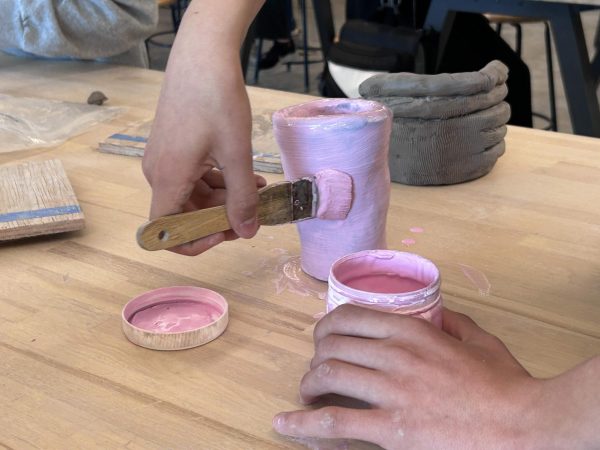
Being enrolled in art classes outside of the clay club, such as AP Drawing, Kabay likes to focus on creating less practical and more abstract pieces of art in any medium. Thinking outside of the box allowed Kabay’s creativity to shine when creating clay artwork.
“Last semester, I was in ceramics two, and one of the required projects [was] to do a teapot set… I don’t really like making functional stuff just because I think it’s boring if I’m not gonna use it, so I tried to find a creative way to do that, which was a challenge… I just tried to think, how could I make it different or unique or fun to make,” Kabay said.
When asked on the current location of the mugs he made for class, Kabay clarified that they were submitted to be a part of his senior portfolio at a gallery hosted by the Illinois High School Art Exhibition (IHSAE).
Kabay had his clay artwork selected to participate in both the IHSAE General and Senior Student Exhibition. Students apply to have selected pieces of artwork be showcased in the art exhibition, with senior students sending their entire personal portfolio, a set of five to 20 pieces of art. The exhibition is hosted on April. 19, with thousands of students from across the Chicagoland area submitting their artwork beforehand the previous year.
Kabay is excited for his portfolio to be showcased at the next IHSAE gallery event.
“I’m excited because last year I went to the show, but I didn’t have anything in it… I’m really excited to see my own stuff in a gallery because it [is] just so different to see your friends or other people’s stuff, but then to see yours in a big gallery like that, it’s cool,” Kabay said.
Art teacher and clay club supervisor Janet Taylor discussed the purpose of the club, and the safe creative space she hopes it provides.
“I would say [the] clay club is more of a space for kids to feel safe and welcome and come and work and feel comfortable. I think most kids come here because they want the time to work and create… The purpose is really to give space to the kids,” Taylor said.
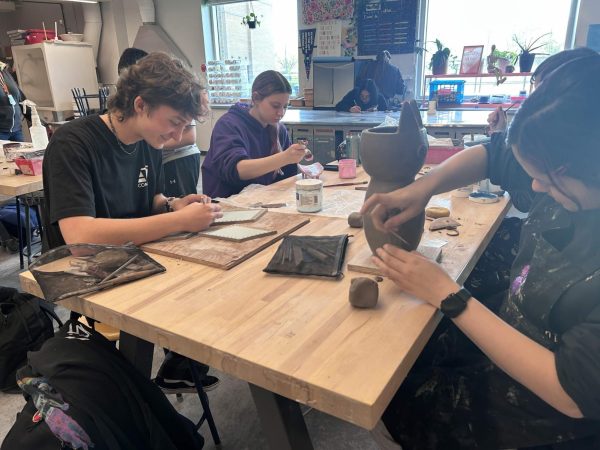
Taylor was first approached to become supervisor by Kabay and Eilee Flannery, another senior clay club member. Previous clay club supervisor and ceramics teacher Molly O’Brien Prusa had previously retired from the role, and the club needed to find a new supervisor to stay active. Taylor at first was apprehensive, but Kabay and Flannery’s request convinced her.
“At the time, I was like, I don’t know if I can [add] one more thing to my plate… I said all right, I will do [supervise the clay club] if you guys become the leaders of the clay club, they said sure. So [the] clay club has continued for the last two years, thanks to [Flannery and Kabay],” Taylor said.
At the beginning of the school year, the club received a massive influx of brand new students interested in trying out clay for the first time. Taylor begins club every year by introducing these new students to the basics of clay art.
“In the beginning of the semester, we get so many kids interested because we get a lot of freshmen who are looking for a club… A lot of those kids have not experienced clay or don’t know how you use it… So I’m always starting to have them [learn] how to touch the clay, how to roll the clay, how to attach the clay [and] how to make a pinch pad,” Taylor said.
However, the club only allows a maximum of 24 students to be accepted as members, with each student paying a fee covering art materials and repair tools. Taylor has noticed that after the beginning of the year, more interested students come to the clay club who can’t be accepted due to the student limit.
“People will just show up who have never signed up for clay club and I’m not gonna turn you away… It’s really a difficult thing with numbers, because I can’t have everybody come, then there’s not enough room. So right now I have more than 24 [kids], I think I have 30 signed up for clay club,” Taylor said.
During the start of the first semester, clay club members commonly participate in a clay pumpkin activity, which has been a yearly tradition since the club’s inception. Since Taylor became supervisor two years ago, new additions such as mini clay ghosts and pinchpacos have been added. Taylor enjoys how this activity brings both new and old members together.
“I asked [Kabay and Flannery] when we started the club back up, what [is] something that you guys typically do every year… and they [said] pumpkins. I love it, because the kids that know how to do it from years past are the ones that teach it and lead it for the kids that don’t know how to use clay that well,” Taylor said.
Throughout her two years as supervisor for the clay club, Taylor has noticed a constant showcase of leadership skills by club members. Students regularly step up to aid Taylor in running club activities or helping lend materials during club time. Taylor was worried that students would need more assistance during club time, but was surprised by their independence.
“I was worried because I thought that kids would need a lot more structure and support, and they really didn’t; once we got kind of rolling, kids really kind of helped each other… I’m lucky, because I just get to be here and hang out and see cool things and help them create their pieces,” Taylor said.
Through clay club and other artistic clubs and classes Kabay has been able to make numerous connections with like-minded artists, perfect his craft and learn more about himself.
“I’d say the biggest thing is just being involved in all the different art clubs has made me make so many new friends…When you surround yourself with people that love the same things as you, it just is that much easier to start talking to people…You just learn more about yourself and more about the people around you that you want to make connections with,” Kabay said.
Before the end of the 2024-2025 school year, physics teacher Stephen Zownorega was the main supervisor of the esports club. Zownorega was first approached by students interested in video games to start a “Super Smash Bros.” club over a decade ago. Over time, the club evolved into a wider esports club, with Zowneraga and the school being approached by the Illinois Highschool esports Association (IHSEA).
“10-12 years ago, I had a group of students who were really into Smash Brothers… We started doing some weekly meetings at that club, and then that grew to an area where esports started to get really serious, and then the IHSEA group picked them up as being one of the events [Smash Brothers] that IHSEA actually runs,” Zownerega said.
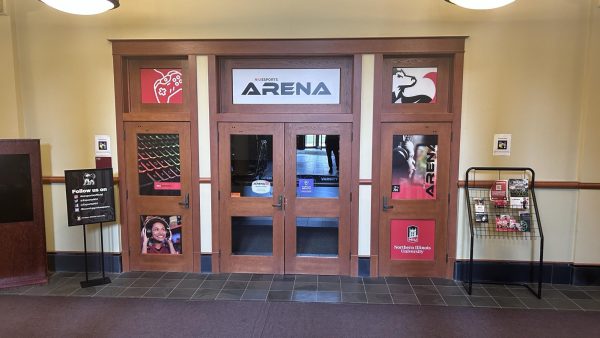
The IHSEA is a statewide organization focused on giving high schoolers the ability to compete in a variety of video games in a competitive environment. Schools in the association’s roster compete in online and in-person tournaments around the state, with larger in person events most commonly hosted by Northern Illinois University.
“[IHSEA] did conferences, they came out and talked to activities directors, they had onboarding sessions. They did a really amazing job getting leadership individuals on board, teachers on board…So the IHSEA was paramount in terms of creating a competitive environment and getting local tournaments out there,” Zowneraga said.
Seeing a potential for growth, Zowneraga and the “Super Smash Bros.” club began to compete in official IHSEA tournaments, rebranding the club to the esports club around five years ago.
Zowneraga noted how much the sports club changed over time, with popular games at the time reflected by student interest in specific games during esports season.
“I think it ebbs and flows with the games that are out there. I know we were really into Mario Kart for a chunk of time…We had a really strong Valorant team, I think I had over 30, 40 students, who came out for that when we first introduced it back when Valorant was [a] new [and] hot game,” Zowneraga said.
For senior Adrian Herres, participating in this widespread competitive environment was spontaneous. Herres first learned of the esports club during his sophomore year, when one of his friends discovered the club during Mustang Fury.
As a sophomore, Herres was a member of the esports club Mario Kart 8 Deluxe junior varsity team, which participated in local tournaments around the state against other competing schools in the league. After his sophomore year, Zowneraga reached out to have Herres become coach for the club’s Mario Kart team. Herres agreed, having enjoyed his time at the club beforehand.
“I enjoyed it the year before, and since most of the players were seniors my sophomore year, a lot of them weren’t available my junior year. So I thought it would be fun, and someone needed to step up and do it.
Zowneraga had responsibilities of his own, having spent a majority of his time during working hours communicating with other schools a part of the IHSEA, sending emails and managing the esports club.
“I think any teacher that does a sport or any activity takes on a lot when they do decide to stay after school with a group of students and organize that, so it does eat up a lot of your time…I remember spending a lot of my hours trying to organize, email students, communicate and then hold things here after school, where I would be here for a couple hours,” Zowneraga said.
As coach for the Mario Kart team, Herres was also required to keep in contact with other schools part of the IHSEA and coordinate online tournaments. Communicating with other schools and training his teammates opened Herres’ eyes to how different supervising a game at a competitive level was.
“Being a player, you know that you’re on a team, but in a game like Mario Kart, you’re usually more focused on yourself and what you’re doing. But as a coach, [it] really opens your eyes to the whole teamwork aspect of it…it’s important for the team to coordinate, “ Herres said.
Outside of competing against other schools remotely via Mario Kart’s own online capabilities, Herres and the rest of the Mario Kart team practiced against one another in a portion of the club room. Herres noted how this experience allowed them to better understand their own weakness in the gameplay and skills.
“So we just have all the games set up there, and we would all play through the Wi-Fi, and we’ll all be in one lobby together, and it really just helped. Because there we were playing more against each other instead of as a team. So we were able to just see each person’s own weaknesses and strong points.
Herres also looked forward to participating in the larger in-person tournaments, meeting his team’s competitors in person and connecting with the wider esports community.
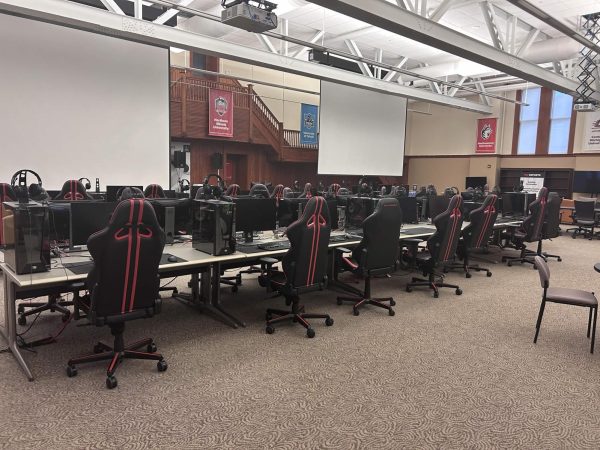
“It was just fun, there were a lot of different people… People would be carrying around bags and stuff [with] their favorite game characters and all that. So you can just look at people and be like, ‘Oh, hey, I know that character’, and just talk with them about that,” Herres said.
Herres’ time participating in the esports club as both a normal player and as a coach played a role in his participation in wider extracurricular activities, allowing him to pursue brand new interests he otherwise wouldn’t have.
“[Esports] helped me branch out more, because my freshman year, I didn’t really do any clubs or activities apart from occasionally doing some journalism stuff. But after doing esports, the year after that, you know, I joined cross-country, and then after cross-country, I joined short film… So I feel after just being with esports and experiencing being in an activity and working with a team of people, it just helped me to really branch out more and explore other areas of interest,” Herres said.
Before the end of Herres’ junior year, Zownorega stepped down from his position as supervisor, with the club taking too much time out of his personal life; many of the club’s long lasting senior members were graduating as well. To Zownorega, it was the perfect goodbye moment.
“I know a lot of people have put effort into it, but I wouldn’t tell you that I don’t think there was a negative or a positive reaction… It was just like perfectly timed moving on, and the seniors were graduating, it was like a goodbye. I think so…It was a good goodbye,” Zowneraga said.
The esports club lasted until the end of the 2024-2025 school year. As of the 2025-2026 school year, DGS does not list the club as part of its list of non-athletic extracurricular activities.
Participation in extracurricular activities allows for growth in a student’s skills and social network, allowing like-minded individuals to meet over their shared interests. Running a club as a supervisor takes both time and effort on the part of the teacher, with them being responsible for creating an environment for students to have fun and grow. However, that responsibility is also equally rewarding in the joy and passion it brings to both students and teachers.
So as students and teachers begin to file into their classrooms at 3:30 p.m., they should recognize the time and effort being put into the everyday activities, competition and supervising that allow extracurricular activities to exist today.