




When companies like AncestryDNA and 23andMe first promised to reveal hidden truths about ancestry and the past, millions of people eagerly swabbed their cheeks and mailed in their DNA. For students like Ariana Mastny, ancestry information provides a sense of connection.
“It’s kind of a way to figure out who you are and to relate with other identities,” Mastny said. “A lot of people can find comfort and feel accepted within a culture.”
Curiosity about ancestry is hardly new, but DNA testing has transformed it into a scientific experiment, a medical advancement and a pathway to discovering new family connections, or even genetic risks. Biology teacher James Workman believes humans’ fascination with family is deeply rooted in evolution.
“There’s something called kin selection, the way that organisms will make sacrifices to ensure their most related genes persist. Our ancestry is our family, and we have this inherent interest in our families. It’s just a part of how evolution works,” Workman said.
But as DNA testing grows more popular, questions about ethics, potential risks and whether sending out genetic information is really necessary have grown louder. Law teacher Gregory Maloney warns that sharing DNA comes with many risks that people do not anticipate.
“Any time you put information out there, particularly to a commercial business, you don’t know what they’re going to do with that information. There are people who are a lot smarter technologically, who can probably steal things from you, or I suppose, steal your identity,” Maloney said.
Maloney alludes to a safer alternative when discovering ancestry information.
“There are websites out there where you don’t put in any of your own DNA. You just put in, as far as you know, names from generations back. It’s more of a community rather than putting in tons of personal information,” Maloney said.
Despite the risks, students remain fascinated by DNA and its possibilities. Senior Elle Enriquez believes her interests are personal.
“I have a really big family, especially on my dad’s side. My grandpa, like where he was born and what his nationality is, is something I’ve never known. He’s not alive anymore, so I can’t really just ask him. People are just curious for more information and to have those details about their lives,” Enriquez said.
However, despite personal curiosity, sharing DNA commercially is a risk in and of itself. It is a quick and easy way to learn about your ancestry and build a genetic profile, but it involves many potential consequences socially, economically and even legally.
Maloney provides insight into how the sharing of genetic information can quickly shift to legal involvement.
“The use of genealogy databases in the investigation of a crime is definitely legal. Essentially, [these databases] are like a third party. Anytime you give information to a third party on your own accord, that information can be accessed by the police without a warrant,” Maloney said.
Maloney further explains the legality of the matter.
“The example I always use is buying an airline ticket: you have to put a lot of your personal information in because they want to do a background check and make sure you’re safe. That information can be obtained by the police as part of an investigation, without a warrant and without your knowledge; so the police could go to these DNA companies and gain more information on a person of interest for a crime, and there’s nothing you can do to stop them,” Maloney said.
As society grows more technologically advanced, the question of potential risks expands. Enriquez shares that even with advancements, her viewpoint stays consistent.
“I don’t think I would change my mind because I have a positive outlook on [DNA testing] already. Hopefully, it can only get better,” Enriquez said. “Maybe with AI it could get worse, but I don’t really see that happening.”
Mastny agreed with Enriquez’s positive outlook.
“I would [submit my DNA] as I don’t really see a problem with it since I have nothing to hide. As technology advances, I would be more likely to send it because there’s more good that they could do with it,” Mastny said.
Maloney, however, shared a more cautious perspective.
“I think as technology advances, more and more people can hack into these companies and gain or leak genetic information. It will become more likely that people find ways to use [the information] for their own commercial gain or to frame people for crimes,” Maloney said.
Despite concerns about the commercial side of DNA testing, many recognize the huge medical advancements that can arise from it.
Enriquez shared her viewpoints on the potential scientific benefits of professional genetic sharing and testing.
“I think it’s really cool. A lot of the diseases I’ve learned about, like cancer, are from things in your DNA. If we could find something to genetically code DNA so that nobody could ever get cancer again, we could end a lot of suffering. It’s cool to think where the future is going with that,” Enriquez said.
Mastny agreed that genetic testing offers possibilities for scientific advancement.
“I think [the changing of DNA] is a really good path that we should be studying … it can help us as a species to survive and prevent suffering from diseases,” Mastny said.
Workman believes the concerns about scientific DNA testing and genetic interference are often misunderstood and misjudged.
“People have weird ideas that it’s changing our genetics, but so does a virus. Every time a virus infects you, your cells genetically mutate,” Workman said.
He believes that the positives of DNA sequencing and mapping outweigh the negatives.
“I think that with cancer therapy, where they go in and sequence the cancer, and mark the cancerous cells so that our immune system can go in and fight them, rather than taking in huge amounts of poison and chemicals involved in chemotherapy, or suffering through radiation therapy is amazing,” Workman said.
While commercial DNA kits provide quick answers about heritage, many advise that the long-term implications are far more complex, and questionable of whether or not they are worth the risk. The same genetic code that can reveal ancestry can also expose personal information when placed in the hands of third-party companies.
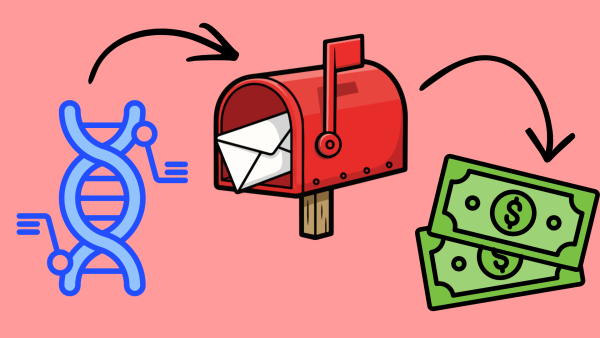
However, professional scientific research differs greatly from voluntarily mailing a saliva sample to a corporation. In medical settings, genetic sequencing is used to treat disease, develop targeted therapies and make medical advancements.
Maloney shares a common thread regarding the matter.
“Any time you share any kind of personal information, you’re taking a risk, and DNA is just another part of that,” Maloney said.
As technology continues to evolve, DNA will likely play an even larger role in medicine and society. The challenge that genetic testing poses to the public is the balancing of curiosity with caution.